Front vs Rear Dust Extraction in Diamond Core Drilling: What’s the Difference?

Share
When you’re diamond core drilling all day, dust control isn’t a “nice to have”; it’s the difference between a safe, efficient job and a site that fails compliance checks.
For many EIBENSTOCK users, the big question is whether to set up front- or rear-dust extraction on their core drills, and when each makes sense. This guide walks you through the practical differences, enabling you to choose the right approach for your next job.
What Do We Mean By Front vs Rear Dust Extraction?
Front dust extraction
Front extraction captures dust right at the mouth of the core bit. Typically, this is done with a:
- Suction ring or dust shroud that seals around the drilling area (e.g. EIBENSTOCK UAR dust suction rings)
- Hose connection to a suitable extractor
- A vacuum that holds the ring onto the surface while pulling dust and slurry away
In practice, you position the ring on the wall or floor, connect the vacuum, and the suction ring “sticks” in place while you drill through the centre. Dust and slurry are captured as they exit the hole.
Rear dust extraction
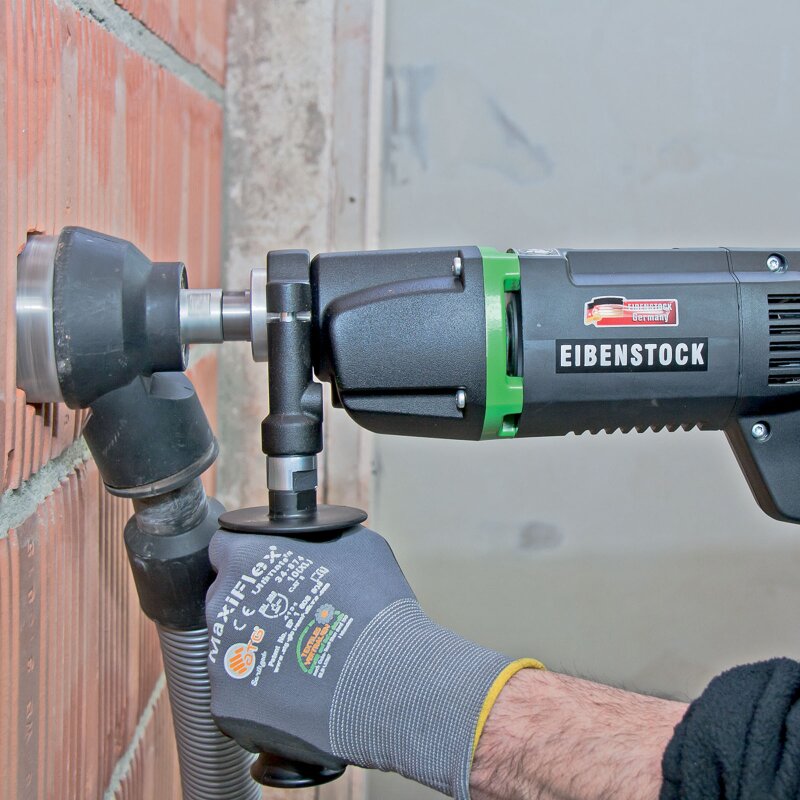
Rear extraction pulls dust back through the core barrel and spindle end. It normally uses:
- A dust swivel or back-end connector between the drill and the core bit
- An internal pilot rod or pick-up that channels dust into the swivel
- A vacuum hose connected directly to the swivel
This is often referred to as back-end or dust swivel extraction, and is common with EIBENSTOCK-style M18 to 1¼” adaptors and swivels compatible with dry core drills.
How Each System Works On-Site
Front extraction in action
With a front dust ring, such as the EIBENSTOCK UAR 162 G or UAR 252 G, the extractor creates a seal between the ring and the surface. As you drill, dust and slurry are captured around the perimeter of the core and drawn away almost immediately
Key characteristics:
- Works for wet and dry drilling
- Excellent for series drilling where you’re moving along a line of holes
- Particularly effective on smooth surfaces where the ring can seal well
- Minimises mess on finished interiors, tiles, painted walls, and ceilings
Rear extraction in action
Rear extraction depends on the core barrel acting as a duct. A dust swivel mounted between the drill and the core bit connects to the vacuum. The pilot rod and core design allows airflow from the cutting edge back through the barrel, carrying dust with it and out through the swivel.
On many EIBENSTOCK drills, including integrated systems such as the PLD 182, the extraction pathway is built directly into the machine, reducing setup time and ensuring consistent airflow.
Key characteristics:
- Best suited to dry drilling
- Keeps the working area around the hole clearer, as dust travels backwards
- Depends heavily on core design, connectors and vacuum performance
- Can be used where front access is limited, or the surface is uneven
Use-Case Comparison: Vertical, Overhead and Confined spaces
Vertical drilling in walls
- Front extraction is ideal when working on finished or nearly finished surfaces, such as drilling for HVAC penetrations or kitchen extractors in occupied properties. The suction ring reduces dust spread and protects decor.
- Rear extraction comes into its own on rougher substrates or when pushing larger cores at higher speeds, and doesn’t necessarily need a ring on the wall, e.g., pre-plaster service runs in blockwork.
Rule of thumb: Both front and rear extraction improve cleanliness on site, but rear dust extraction is often faster for dry drilling, thanks to a simpler setup and fewer accessories. Front extraction comes into its own when wet drilling is required, as it’s the most effective option for capturing slurry and maintaining control at the cutting face.
Overhead drilling in ceilings
Overhead work is where dust control has a significant impact on comfort and safety.
- Front extraction with a universal dust ring is extremely effective overhead because the ring and vacuum catch most material before gravity pulls it down. It’s a strong choice in occupied buildings and refurbishment jobs.
- Rear extraction still helps, but some dust will escape from the core’s front edge unless combined with an additional shroud. It’s more appropriate in structural or shell-and-core work where minor dust escape is acceptable.
Pros and Cons: Effectiveness, Compatibility and Maintenance
Front extraction
Advantages
- Very visible dust control, clients and inspectors can see it working
- Works for wet or dry drilling with the right ring
- Great for overhead and finished surfaces
- Compatible with multiple drill types, handheld or rig-mounted
Considerations
- Needs a suitable surface for the ring to seal against
- An extra step to position the ring each time
- Seals and rubber components need occasional cleaning and inspection
Rear extraction
Advantages
- Clean, compact setup, nothing extra on the wall
- Excellent for continuous dry drilling in softer masonry
- Works well with EIBENSTOCK dry core drills and M18-based connectors and swivels
Considerations
- Relies on the core barrel staying clear inside; blockage kills efficiency
- Requires a solid barrel core to use rear extraction properly and effectively
- Not ideal for heavy slurry when drilling wet
- Connectors and swivels need to be kept free of debris and checked for wear
Health & Safety and Silica Dust Compliance
Silica-containing mineral dust is classified as a serious health risk, linked to lung diseases and cancer. EIBENSTOCK literature is very clear: hazardous dust must be captured using a suitable vacuum, typically Class M, and they specifically recommend their DSS vacuum range for this purpose.
Whether you choose front or rear extraction, keep these essentials in mind:
- Use a Class M or higher dust extractor for silica dust
- Match airflow to your setup; large cores and long hoses need more suction
- Maintain proper seals, hoses and connectors; small leaks massively reduce performance
- Combine extraction with RPE (respiratory protective equipment) and good ventilation where necessary
Dust extraction isn’t just about a tidy site; it’s about meeting regulations and protecting your team.
Equipment Required for Each Method
Front extraction setup
A typical front extraction kit for diamond core drilling might include:
- An EIBENSTOCK-compatible core drill designed for use with external front-mounted extraction, such as the EHD 2002, which uses front extraction without the need for a rear dust swivel.
- A universal dust suction ring, such as the UAR 162 G or UAR 252 G, depending on the diameter range.
- A suitable EIBENSTOCK dust extractor matched to the job.
- Approved hoses and adaptors to connect the ring to the vacuum securely.
Rear extraction setup
A rear extraction system typically uses:
- An EIBENSTOCK core drill with integrated rear dust extraction, such as the ETN 162/3, where dust is drawn back through the spindle rather than via a front-mounted ring.
- Back-end dust swivel and connector, such as an M18 to 1¼” dust extraction adaptor, designed to suit EIBENSTOCK diamond dry drills.
- Matching dry diamond cores and, where required, pilot rods and guide devices.
- A Class M and H EIBENSTOCK DSS extractor with adequate airflow.
Getting the thread sizes and connector types right (M18, ½” BSP, 1¼” UNC, etc.) is critical; this is where sticking with a complete EIBENSTOCK system pays off, because the drills, swivels, cores, dust rings and vacuums are designed to work together.
Which Should You Choose, Front or Rear Extraction?
You don’t need to be loyal to one method forever; most contractors end up using both depending on the job. As a quick guide:
Choose front extraction when:
- You’re working in occupied or finished spaces
- Overhead dust and slurry must be tightly controlled
- You want a very visible, client-friendly dust management setup
Choose rear extraction when:
- You’re doing high-volume dry drilling in masonry, block or brick
- You’re working in occupied spaces
- You prefer an effective setup which catches all possible dust
Combine both when:
You’re drilling demanding materials where you want belt-and-braces protection, rear extraction through the core, plus a front suction ring to catch any escape.
Putting It Into Practice with EIBENSTOCK Dust Extraction Systems
The most effective dust control isn’t just about choosing between front or rear extraction; it’s about putting together a matched system: core drill, cores, adaptors, suction ring, and extractor all working as one. With EIBENSTOCK’s core drills, dust swivels, UAR universal dust rings and vacuum range, you can configure the right setup for vertical, overhead or confined-space drilling while staying on the right side of silica dust regulations.
If you’re planning a new drilling setup or want to upgrade from basic vac-and-broom methods, use this front vs. rear extraction guide as a starting point, then consult with our expert team to determine the right drill, accessories, and dust extractor for your work style.